
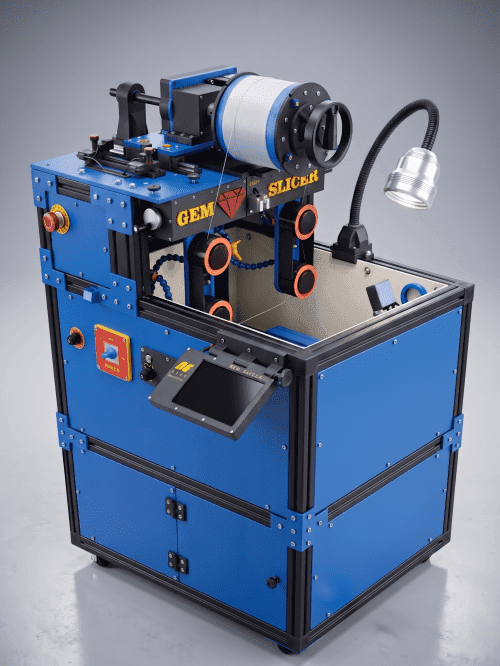
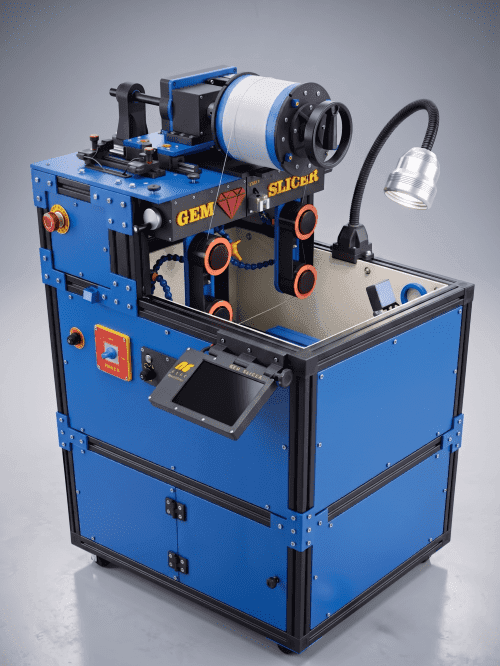
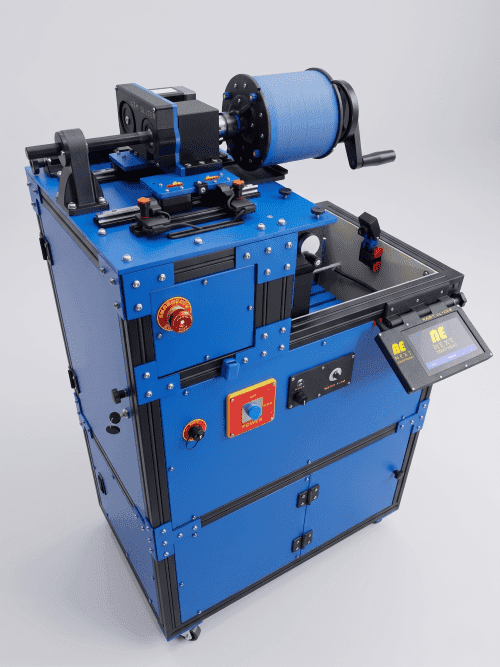
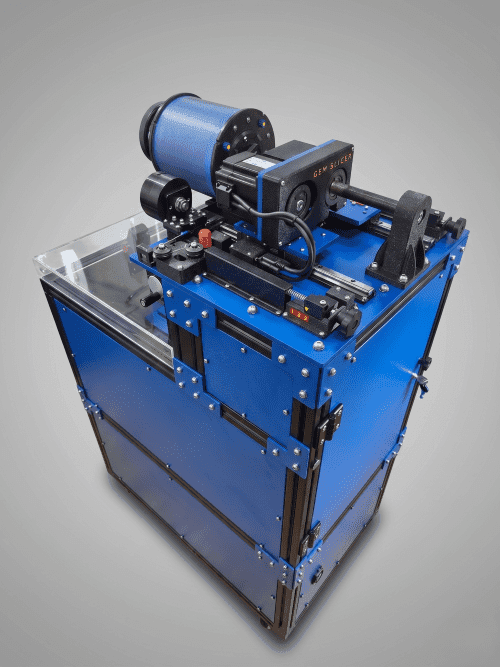
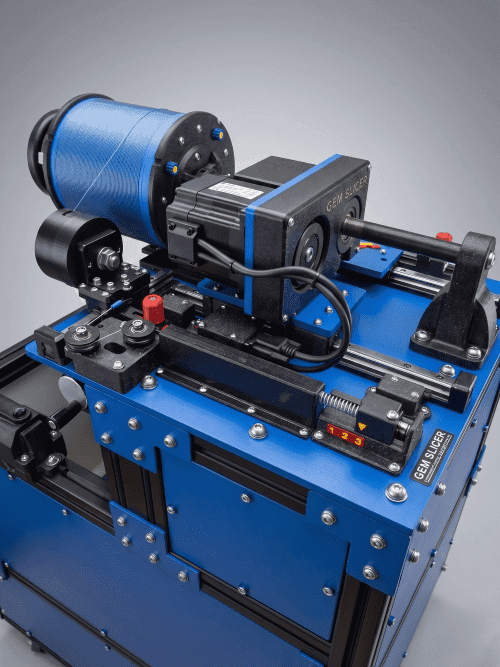
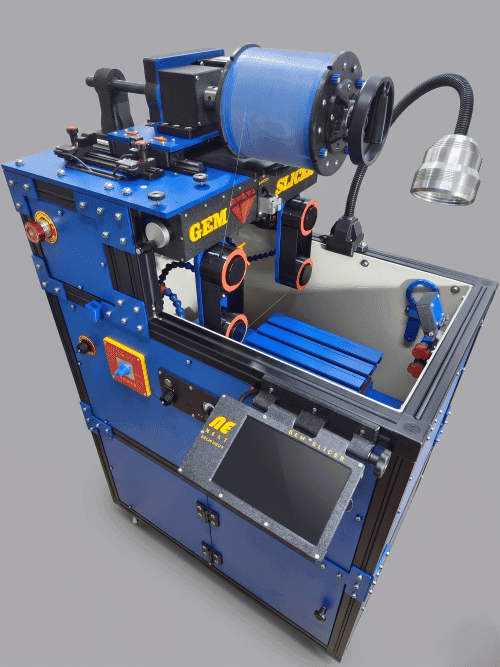
The Standard is the machine you buy when cutting is not a step in your work but the work itself. Two hundred millimetres of length, two hundred and twenty of height, a Z axis that carries fifty kilograms, and eighty metres of wire on the spool so a long run finishes without you touching it.
At a Glance
- What it is: a floor-standing precision diamond wire saw with a reciprocating spool wire, for laboratories and workshops that slice stone, meteorites, metals and ceramics.
- Kerf: 0.22 mm with the supplied wire, against 1.5–3 mm for a conventional blade.
- Thinnest slice: 0.25–0.3 mm, verified in brittle stone meteorite; ±0.05 mm at 2 mm.
- Capacity: 200 mm long, 220 mm high, specimens up to 50 kg.
- Unattended cutting: automatic slicing series, two water level sensors that stop the cut, camera and remote access.
- Price and delivery: €15,000 ex VAT, FCA Sofia; up to two months from the 50% deposit, including a 168-hour test run.
- Maker: Next Equipment, Bulgaria. 40+ machines in 15 countries, 2-year warranty, lifetime remote support.
Who It Is For
Metallography and petrography laboratories, alloy quality control, universities and research groups — the same work the Mini does, but on larger samples and in longer runs. Cutting farms and lapidary businesses working batches rather than single stones. Meteorite and mineral dealers slicing material where every millimetre lost is money gone.
It is a floor-standing machine: 135 cm tall, 70 kg, and it needs its own space rather than a corner of a worktop. If bench mounting matters more to you than capacity, the Gem Slicer Mini does the same work at 150 mm and sits on a table.
0.22 mm kerf. Slices down to 0.25 mm. Built to run around the clock.
A 0.22 mm kerf against the 1.5 to 3 mm a conventional blade takes out of your stone. On a 200 mm face that difference is not a rounding error — it is whole slices. Minimum slice thickness 0.25–0.3 mm, verified repeatedly in brittle stone meteorite.
€15,000, ex VAT. FCA Sofia. Payment by bank transfer — 50% deposit, the balance before dispatch. Shipping and insurance are quoted separately and added to your proforma.
Technical Specifications
| Cutting capacity (X / length) | 200 mm |
| Cutting capacity (Z / height) | 220 mm |
| Cutting width | 80 mm to 250 mm, adjustable |
| Specimen mounting | clamped to the platform on the X stage, carried by the Z axis |
| Specimen limit | 50 kg on the Z axis |
| X-axis positioning resolution | 0.02 mm (ball screw) |
| Typical slice tolerance | ±0.05 mm at 2 mm slice thickness |
| Minimum slice thickness | 0.25–0.3 mm, verified in brittle stone meteorite |
| Kerf | 0.22 mm with the supplied open-loop wire; 0.6 mm with closed-loop wire |
| Wire linear speed | 40 to 120 m/min |
| Cutting feed (Z) | 1 to 200 mm/h |
| Wire spool capacity | 80 m; any working length from about 5 m upward, set by the reversing sensors |
| Wire thickness compatibility | 0.1 mm to 0.8 mm |
| Wire types | Open loop (spool) or closed loop, 1.6 m — built for both since the first model |
| Closed-loop changeover | About five minutes with the two ER32 spanners supplied; adapter in preparation |
| Power | 110–240 V auto-switch (global compatibility) |
| Power consumption | up to 300 W |
| Noise | 55 dB |
| Cooling and water | self-contained 2-stage purification, internal pump |
| Water level monitoring | two-stage: on-screen warning, then automatic stop |
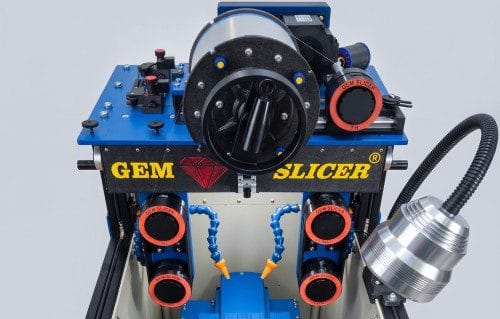
| Positioning laser | projects the cutting plane onto the specimen before the cut |
| Hour meter | counts Z-axis running time, shown on screen |
| Control interface | 8-inch touch panel |
| Connectivity | Wi-Fi, LAN, integrated camera, AnyDesk |
| Installation | floor-standing |
| Machine dimensions | 135 cm H × 52 cm W × 80 cm D |
| Machine weight | 70 kg |
| Current lead time | Up to two months from the 50% deposit to dispatch, including the 168-hour test run |
Measured on Camera
Everything above is a specification. Below it is measured. Both videos were shot on a Gem Slicer Mini — the two machines run the same software, the same 0.22 mm wire and the same X-axis positioning resolution, and we publish the same tolerances for both; the Mini simply takes smaller specimens. The material is weathered stone meteorite: brittle, and the hardest case there is for thin slices.
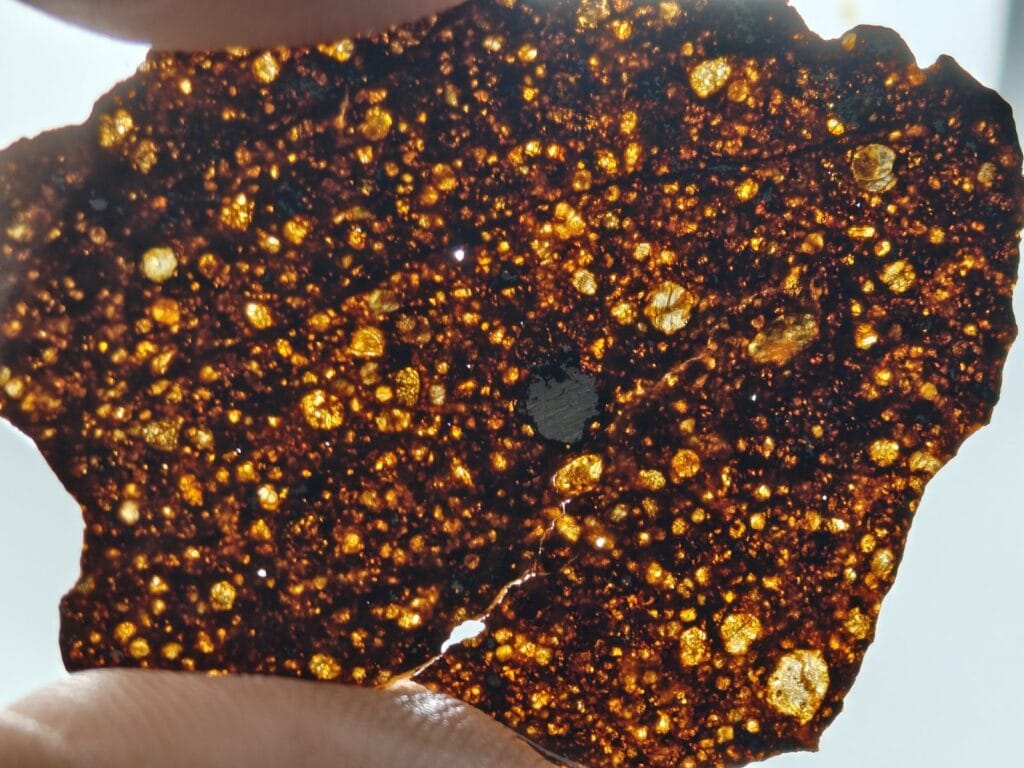
Three slices at a nominal 2.00 mm, measured with a micrometer: 1.951 mm, 1.970 mm, 1.979 mm. A spread of 0.028 mm across the three, all inside the ±0.05 mm stated above. They are not consecutive slices — other thicknesses were cut from the same specimen in between.
All three read slightly under nominal, and that is worth understanding before you buy any wire saw. The machine advances the X axis by slice thickness plus wire thickness, and wire thickness is a parameter you enter. Enter 0.22 mm — the wire itself — and slices come out a few hundredths thin, because the real kerf is a little wider than the bare wire. Measure one slice, enter the real figure, and nominal becomes delivered. That offset is systematic, so it calibrates out. The spread does not — and the spread is what tells you what the machine will hold.
How thin it will go in the same material: 0.282 mm, 0.191 mm, 0.207 mm. We publish 0.25–0.3 mm as the minimum rather than 0.19, because below about a quarter of a millimetre not every slice survives — the remaining wall gives way under the wire before the pass finishes. The figure on this page is the one you can plan around, not the best one we have hit.
How the Standard Feeds the Stone
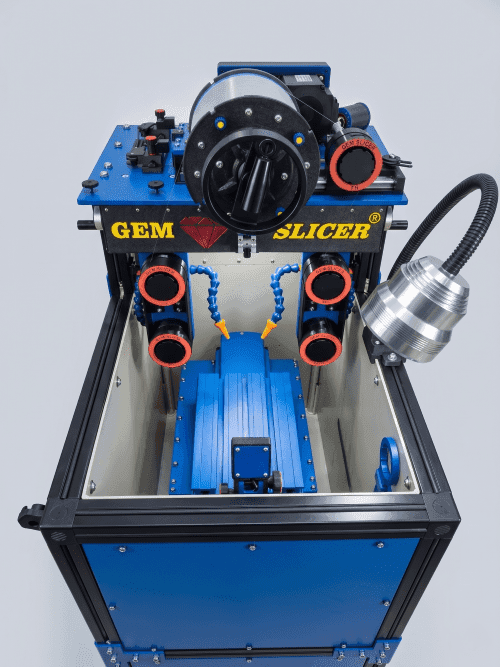
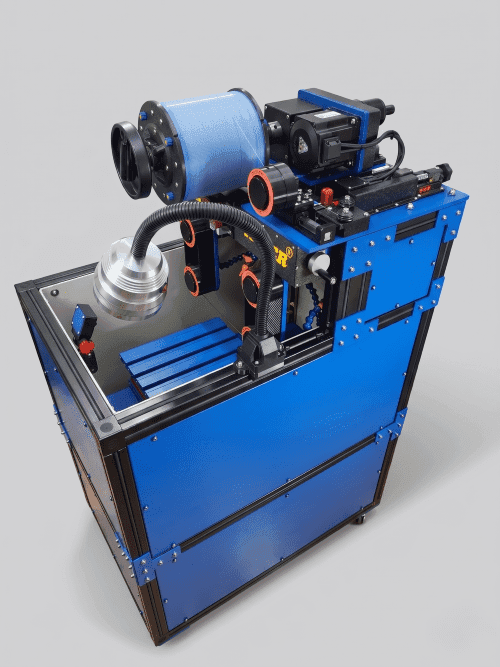
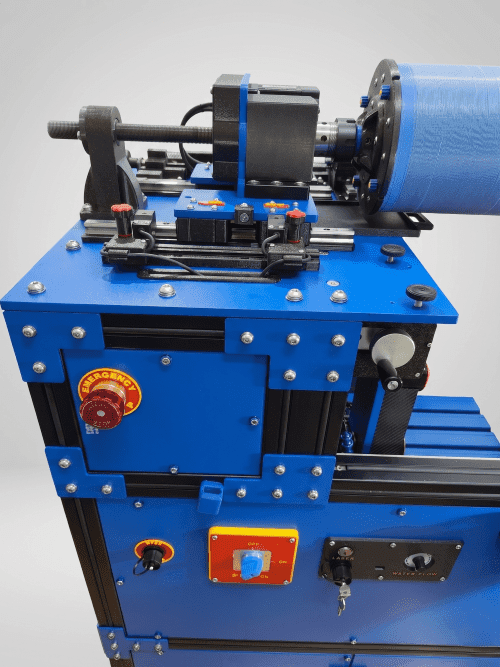
The Z axis is a moving stage, not a descending head. The X table sits on Z, the specimen platform sits on X, and the whole assembly lifts the stone up into the running wire. That is why the 50 kg Z load rating is a real number worth reading: on this machine the axis genuinely carries the specimen, and it is rated to carry a heavy one. The Mini reverses this — there the head moves and the stone stays still.
The Machine Watches Its Own Water
Batch mode is only worth having if the saw can be left alone, and a wire saw left alone has one way to hurt itself: running the water down until the pump is dry.
The Standard carries two level sensors in the water container. The first one warns — the level is getting low, and a message appears on the panel while cutting continues. The second is the hard limit: the water is critically low and the pump is about to run dry, so the cut stops automatically. That is what turns an unattended overnight queue from a gamble into a routine.
Before It Ships: 168 Hours
Every machine runs for a full week before it leaves us. The test simulates real cutting, and the last runs are done dry, so that your machine does not arrive already dirty from our bench.
Then it is stripped down and cleaned completely, and gone over one part at a time: every sensor, every motor, the linear guides, the play on each axis.
Up to two months from your deposit, and one of those weeks is your own machine already working.
What Arrives on Your Loading Dock
The saw ships fully assembled and calibrated on a half-euro pallet inside a heavy-wall carton.
| Package dimensions | 82 × 64 × 150 cm (pallet included) |
| Gross weight | 85 kg |
| Chargeable weight, air freight | approx. 157 kg volumetric |
Those last two lines are there so you can get a freight quote without emailing us first. Air freight is charged on volumetric weight, not actual, and for a crate this tall the volumetric figure is what your forwarder will bill.
The Software
Named functions on the touch panel, not “intelligent automation”: anti-tummy for flat slices on long cuts, Z-retract to straighten the bow the wire takes in very hard or very large material, kerf compensation so the slice you ask for is the slice you get, and automatic cutting that runs a queue unattended with per-group settings. For production work the automatic mode is the one that pays for itself — you queue the night’s cuts and go home.
What the software actually does, function by function →
A Broken Wire Is Not a Lost Loading
The reel reverses between two sensors that slide along a rail, each with an indicator lamp, and their position sets the working length — anything from a few metres up to a full spool. A full loading is around 70 m, but the machine does not insist on one.
This matters on friable material. If the wire parts because the specimen pinched it in the kerf rather than because the wire is worn out, you are not throwing the loading away: remove the short piece, slide the sensors to the length that remains, and carry on cutting with the same wire. Five metres of wire in good condition is a working setup.
Plug & Play. One Hour of Maintenance a Year.
The saw arrives fully assembled and calibrated. Keeping it running costs €90–120 a year in normal use (parts and costs, itemised), and the annual service takes about an hour.
Bearings: fifteen per machine, all standard 6001 RS, sealed — €4 to €6 anywhere in the world. The wire carries water and slurry up to the top rollers, so every bearing works wet; the six in the bottom two rollers wear first. At about 3,000 operating hours, replace the full set of fifteen while the machine is open. The machine counts its own hours from Z-axis running time and shows them on screen, so you never guess from the calendar. Cutting around the clock reaches 3,000 hours in about four months.
Greasing: the Z-axis bearings and the reel guide bearings, periodically. The X axis once a year: open the cover, inspect the bearings, grease.
X-table drain: the X table sets your slice thickness. It is protected against splashes but is not sealed, so it carries a drain that takes away any water that gets under the cover. Check it during the annual service.
Guide rollers: €1 each. The machine runs five at a time and a set lasts two to three months. Drive belt: five years.
When Something Breaks
This is the part most manufacturers leave vague, so here it is precisely. The saw is designed never to come back to Bulgaria. We ship you the part and you fit it yourself. Parts go out the same day. Next day inside EU zone 1 by DHL. Three days to Madagascar. Three days to the USA. We know because we have done it.
Printed parts. The load-bearing structure is aluminium with stainless bolts. The parts that carry no load — caps, covers, water guards — are 3D printed. If one breaks, we send you the file and the print settings and you make it yourself. The guide roller guards we always ship you ourselves.
Two-year warranty, all customers, worldwide. Software support and cutting advice for the life of the machine, included in the price.
In the Box
The machine ships with the consumables to run it and the tools to service it. You will not need a trip to a hardware store in the first year.
- 1,000 m supply spool of 0.22 mm diamond wire — roughly two months of normal cutting. How long one loading lasts depends on the material, the size of the specimen and the cutting parameters, so we quote ranges rather than figures.
- 30 polyamide guide rollers — five fitted, twenty-five spare
- Spool adapter for winding wire from the supply spool onto the machine reel
- 2 × ER32 collet sector spanners, 13 mm box spanner for bearing replacement, guide roller cap wrench, 10 and 18 mm open-end spanners, hex key set, screwdriver
- Diamond wire cutters, spare fasteners, foam PVC adapters for mounting stones, leather gloves
- Operating manual, EC declaration of conformity and warranty card, in the crate with the machine
Not included: shipping and insurance, and the closed-loop wire adapter.
Unpacking: One Assembly Step
The wire reel and its shaft travel detached. The reel sits at the top of the machine, where a knock to the top of the crate in transit would go straight into the shaft — so it ships separately and is mounted on arrival. Two or three minutes with the two ER32 spanners from the toolkit.
Then wind wire onto the machine reel with the supplied spool adapter, fill the water container and start cutting. Loading wire is a routine operation rather than a one-off, which is why the adapter is in the toolkit rather than sold as an extra.
Not Sure How Your Material Will Cut? Send Us a Sample.
A specification describes the machine. It does not describe your rock. Send us a piece of the material you intend to cut. We slice it on the machine you are considering and send the slices back, together with a video of the cut — so you see the feed rate, the surface it leaves and how the saw behaves on your material rather than on ours.
Sample size: up to 5 × 5 cm. That is enough to show the average cutting rate and the quality of the cut face. On hard material a single cut through a larger piece can take a full day and tells you nothing that 5 cm would not.
Within the EU. Shipping in both directions is at the sender’s cost. We recommend insuring the parcel; the transport risk stays with the sender. Please do not ship anything before we have agreed on it.
Outside the EU: talk to us first. We are glad to do this within reason, but a sample leaving and re-entering the EU is a customs matter rather than a postal one, and whether it is workable depends on your country and your material. What comes up in practice:
- Customs clearance in both directions, with the paperwork and the delay that goes with it
- Import duty and VAT charged on the return shipment
- Materials under a special regime — meteorites, which several countries restrict or prohibit for export; protected minerals and fossils; anything covered by CITES, such as coral or ivory
- Radioactive minerals, asbestos-bearing minerals and other hazardous samples, which we do not accept from anywhere
- Gemstones and other high-value pieces, which we do not accept — customs treats them as valuables, and the risk of loss is not one either of us should carry for a test cut
Write to us with the material, the country and what you need to find out. We will tell you honestly whether it can be done.
If shipping is not practical. Describe your material and we will cut the closest equivalent from our own stock and send you the video. It is not your own stone, but it answers the same question.
Mini or Standard?
| Gem Slicer Mini | Gem Slicer Standard | |
|---|---|---|
| Cutting length | 150 mm | 200 mm |
| Cutting height | 150 mm | 220 mm |
| Cutting width | 150 mm | 80–250 mm adjustable |
| Wire spool | 30 m | 80 m |
| Installation | bench-top | floor-standing |
| Control panel | 7-inch | 8-inch |
| Water level monitoring | manual check | two sensors: warning, then automatic stop |
| Cutting motion | head moves, stone fixed in the tank | stone rises into the wire on the Z stage |
| Specimen weight limit | the envelope decides | 50 kg on the Z axis |
| Hour meter, camera, remote access, laser | yes | yes |
| Price | €10,000 | €15,000 |
CE Marking and Conformity
The Gem Slicer Standard carries CE marking. It is declared in conformity with the Machinery Directive 2006/42/EC, the Low Voltage Directive 2014/35/EU and the EMC Directive 2014/30/EU, built to EN ISO 12100, EN ISO 13849-1, EN ISO 13850, EN 60204-1 and the related machine-safety standards. The declaration of conformity ships with every machine.