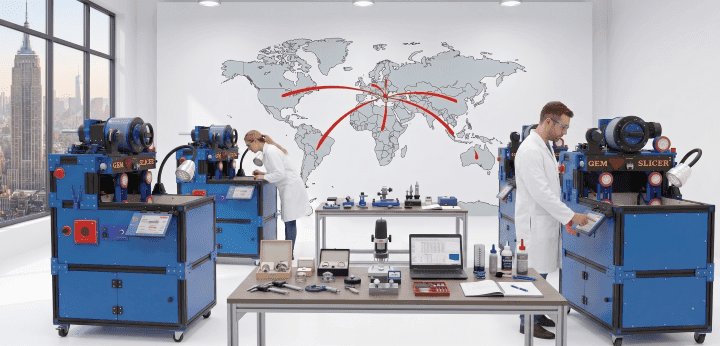
Next Equipment builds diamond wire saws for laboratories, universities, workshops and jewellers — and we cut stone ourselves. Every decision in these machines came from someone standing in front of one. Made by cutters, for cutters.
The wire is 0.22 mm thick. A conventional blade is 1.5 to 3 mm. Slicing a 40 mm specimen at 2 mm, a blade gives you eight slices and turns the rest into dust; 0.22 mm wire gives you eighteen. When the material is worth more than the machine, that difference is the whole argument. How the kerf maths works.
Sixty seconds of it happening: a stone meteorite on a Gem Slicer Mini, and the finished slice held up to the light at the end of the cut.
Two Machines, One Saw
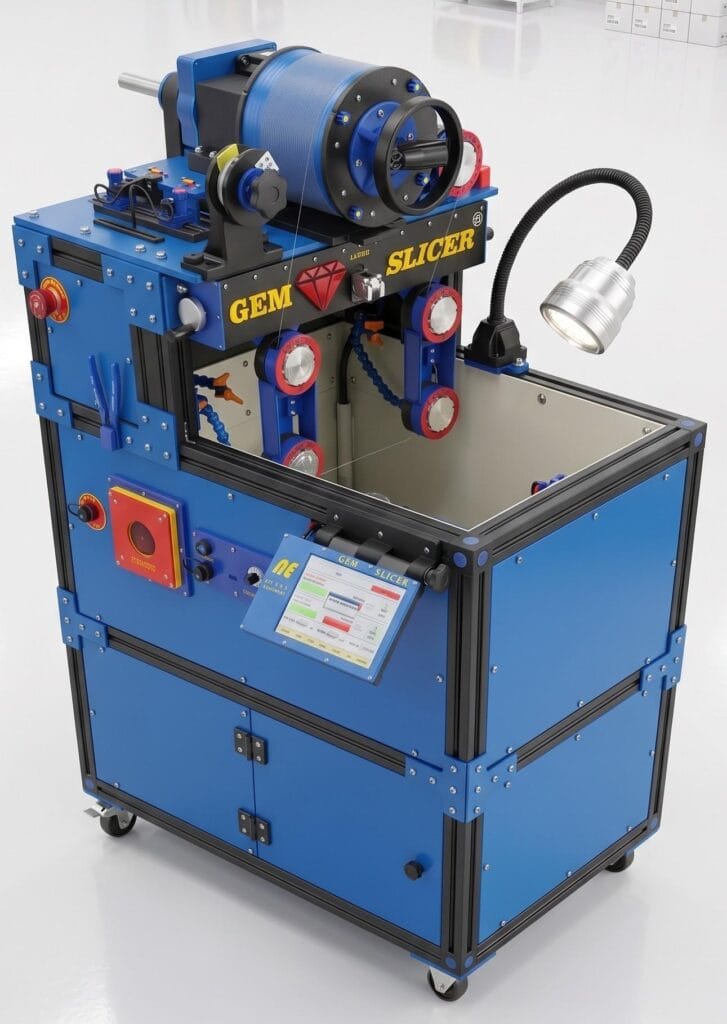
Gem Slicer Standard — €15,000, ex VAT
Floor-standing, 200 mm cutting length, 80 m wire spool. Two water-level sensors watch the coolant: the first warns, the second stops the cut before the pump can run dry, which is what makes an unattended batch overnight a decision rather than a gamble. Full specification.
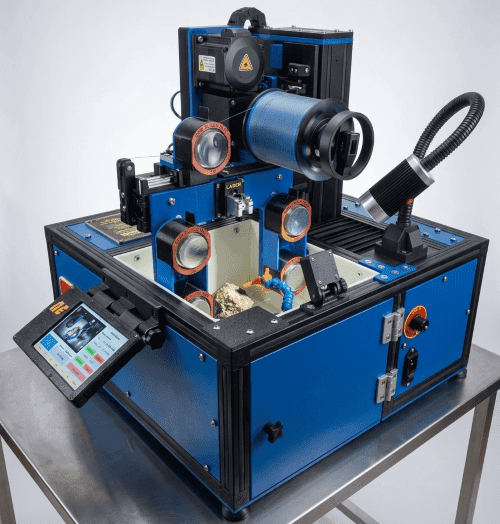
Gem Slicer Mini — €10,000, ex VAT
Benchtop, 150 mm cutting length, and it arrives with 30 m of wire already loaded — out of the crate, fill the water container, cut. Same software, same 0.22 mm wire, same slice tolerance, same camera and remote access. What you give up is capacity and the water sensors, not control. Full specification.
Both machines: ex VAT, FCA Sofia. Payment by bank transfer — 50% deposit, the balance before dispatch. Up to two months from your deposit to dispatch, and one of those weeks is your own machine already running. Shipping and insurance are quoted separately and added to your proforma.
Accuracy, Stated Properly
X-axis positioning resolution is 0.02 mm on the ball screw. The cutting accuracy is not the same number: in practice, expect a slice tolerance of about ±0.05 mm at 2 mm, because the wire deflects in the kerf. The thinnest slices we have taken repeatedly are 0.25–0.3 mm, in brittle stone meteorite. We publish the second number because it is the one you will measure.
What the Software Does
Named functions, not adjectives. Anti-tummy pauses the Z feed at intervals while the reel keeps running, so the wire clears material it left behind. Kerf compensation adds the wire diameter to every step, so the slice you asked for is the slice you get. Auto-slicing works through a batch unattended. A positioning laser projects the cutting plane onto the specimen before you start; a built-in camera and remote access let you watch and control the cut from anywhere — only when you grant it. More about the software.
It Runs Where You Put It
The water is a closed loop: purified and returned, no supply and no drain needed, which is why a Gem Slicer can sit in a laboratory or a rented workshop. Around 55 dB. 110–240 V auto-switching. Every machine runs for 168 hours — a full week — before it is cleaned, checked and shipped.
When Something Breaks
The saw is designed never to come back to Bulgaria. We ship the part and you fit it: same-day dispatch, next day inside the EU, three days to Madagascar and three days to the United States — those are our own shipping records, not a target. Many non-structural parts are 3D printed, and we send you the file and the print settings. Two-year warranty worldwide; software support and cutting advice for the life of the machine, included in the price. Spare parts and service.
Where the Machines Are Working
More than 40 machines in 15 countries across 4 continents — mostly the EU and the USA, but also Madagascar, Morocco and Chile. Among people who slice meteorites, most of the machines in use are ours; that is the niche the Gem Slicer started in. Five years of continuous iteration, machines running around the clock, and any component that turns out to be a weak point is replaced in the next machine we build. More about us.
If the Standard Machine Is Not the Right Machine
We modify, and we build from scratch to a specification — including multi-machine cutting farms for customers who slice in volume. Custom saws and cutting farms.
Meet Us in Munich, 22–25 October 2026
We will be at the Munich Show, stand B2.777, with a Gem Slicer cutting live on the stand. Bring a caliper and measure a slice yourself — that is the point of cutting in public.
Tell Us What You Cut
Send us the material, the size of your specimens, the slice thickness you need and how many. We will tell you which machine fits, what it costs to run, and — if that is the honest answer — that a diamond wire saw is not the right tool for your job. Contact us, or read the frequently asked questions first.