A diamond wire saw cuts with a thin steel wire coated in diamond. Nothing spins fast, nothing is forced through the material. The wire abrades its way down under water, so the specimen never heats up and the edges do not chip.
The number that decides everything else is the kerf — how much of your material the cut turns into dust. Our wire is 0.22 mm. A conventional blade takes 1.5 to 3 mm.
What the Kerf Actually Costs You
Take a 40 mm stone and cut it into 2 mm slices.
With a 3 mm blade, each slice costs you 5 mm of stone. You get eight slices, and 24 mm of your stone leaves as dust.
With our 0.22 mm wire, each slice costs 2.22 mm. You get eighteen slices from the same stone, and 4 mm is lost.
That is not a specification. It is arithmetic you can check, and on material worth more than the machine it is the whole argument.
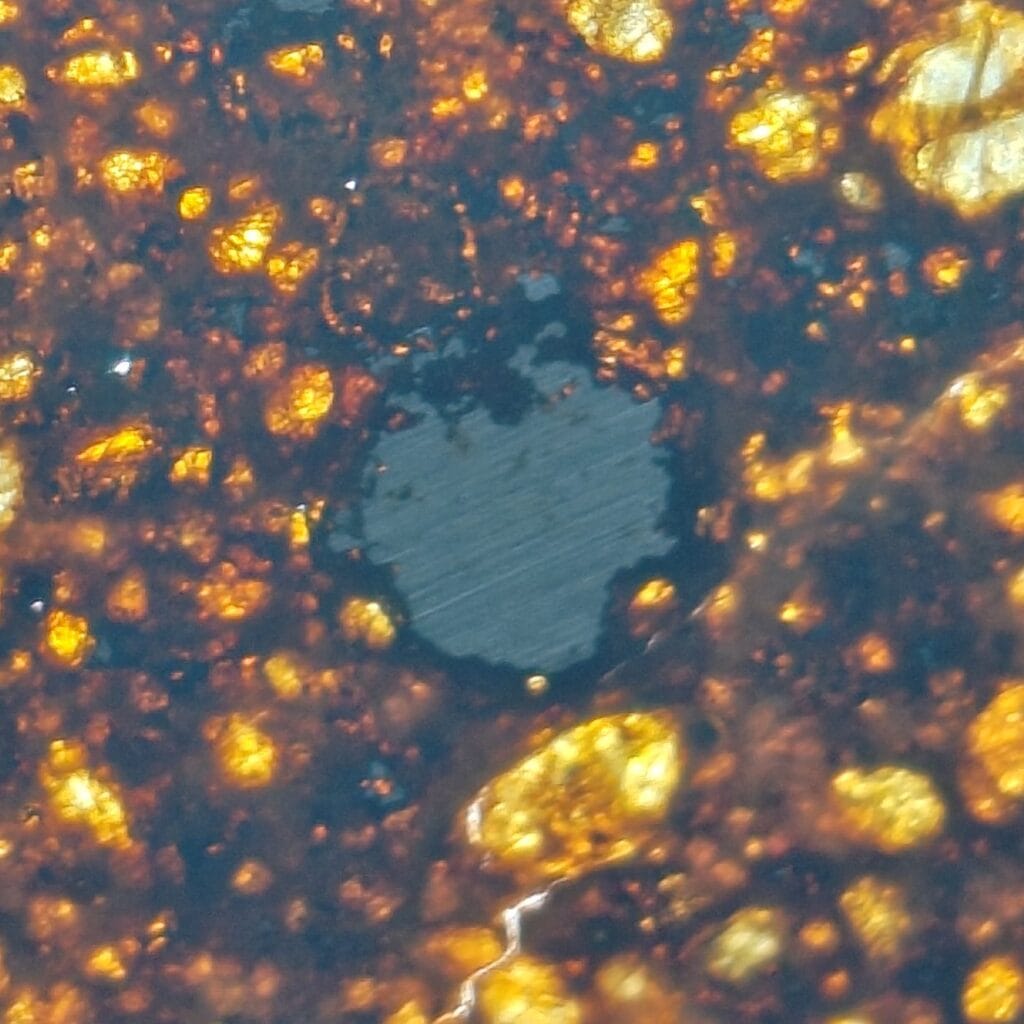
This is what it looks like on the machine: a stone meteorite on a Gem Slicer Mini, and the finished slice held up to the light at the end of the cut.
Two Kinds of Diamond Wire. Both Run on This Machine.
Diamond wire comes in two forms, and most saws are built for one of them.
Open loop is a long wire on a spool. It travels forward and back across the cut. This is what ships with the machine, at 0.22 mm.
Closed loop is a short welded loop — 1.6 m on the Standard, 1 m on the Mini — that runs in one direction and never reverses.
Our saws take both. The changeover takes about five minutes with two ER32 spanners, and the hardware provision has been built into the machine since the first one we made. The closed-loop accessory is bought separately.
Be aware of the trade-off: closed-loop wire is 0.6 mm, so the kerf in that mode is nearly three times the open-loop figure. Neither mode is the better one. You pick per job — and if you are replacing a saw that ran closed-loop wire, your existing stock is not scrap.
We supply both wire types, and our closed-loop source is not one of the machine builders we compete with.
What Our Customers Cut
Metallography and petrography laboratories, alloy quality control, university departments, jewellers, and people who slice meteorites — which is where the Gem Slicer started, and a niche where most of the machines in use today are ours.
The wire does not care whether the material is hard. It cares whether it is brittle, and brittle is exactly where a blade fails.
Accuracy, Stated Properly
X-axis positioning resolution is 0.02 mm on a ball screw. Typical slice tolerance is ±0.05 mm at 2 mm slice thickness. The thinnest slice we have cut repeatedly, and can show you, is 0.25–0.3 mm in brittle stone meteorite.
We publish the tolerance, not just the resolution, because the resolution is what the ball screw does and the tolerance is what you get.
Measured, on camera: three slices from a weathered stone meteorite at 0.282 mm, 0.191 mm and 0.207 mm. We publish 0.25–0.3 mm as the minimum rather than the best figure we have reached, because below about a quarter of a millimetre not every slice survives the cut. The repeatability run at 2 mm, and how the kerf parameter is calibrated, are on the Gem Slicer Standard and Gem Slicer Mini pages.
Choose Your Diamond Wire Saw Model
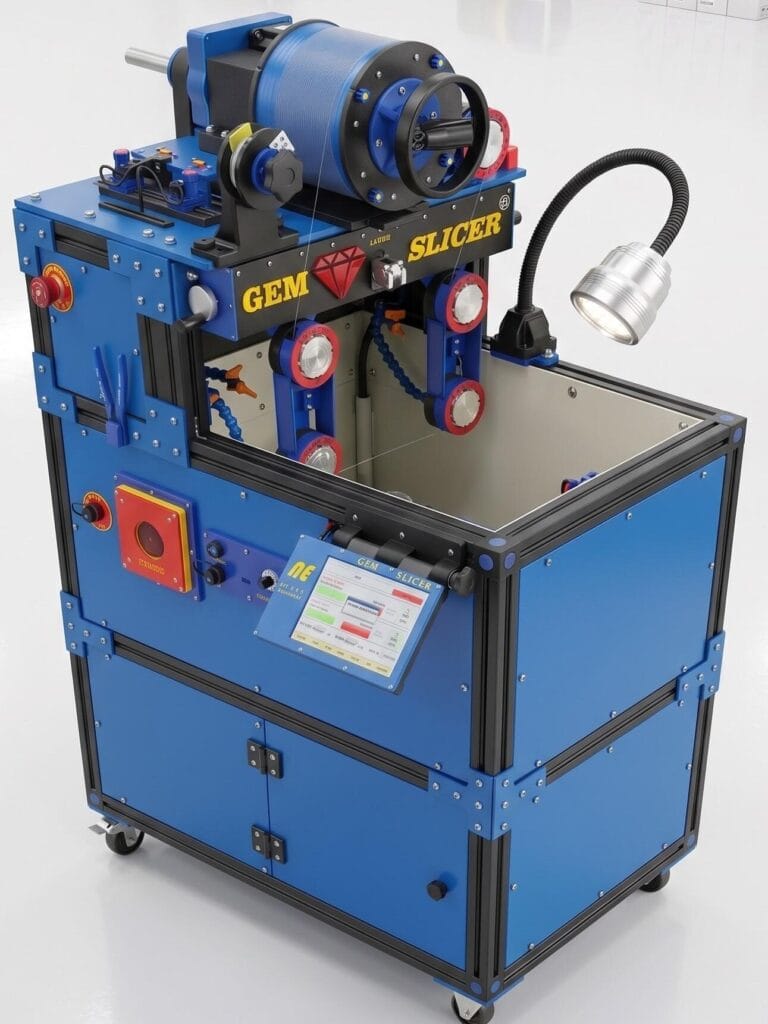
€15,000, ex VAT
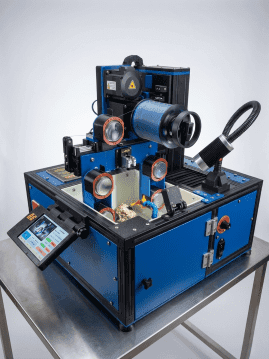
€10,000, ex VAT
Mini or Standard?
| Gem Slicer Mini | Gem Slicer Standard | |
|---|---|---|
| Cut length | 150 mm | 200 mm |
| Cut height | 150 mm | 220 mm |
| Cut width | 150 mm | 80–250 mm, adjustable |
| Wire spool on the machine | 30 m | 80 m |
| Placement | Benchtop | Floor-standing |
| Control panel | 7 inch | 8 inch |
| Water level control | Operator check | Two sensors: warning, then automatic stop |
| Cutting motion | The head travels; the stone rests still in the tank | The stone feeds up to the wire along the Z axis |
| Specimen limit | Governed by size, not weight | 50 kg on the Z axis |
| Hour counter, camera, remote access, laser | Yes | Yes |
| Price | €10,000, ex VAT | €15,000, ex VAT |
And Afterwards
The saw is built never to come back to us. Spare parts ship the same day, next day inside the EU, three days to Madagascar and to the USA. Software support is included for the life of the machine, and the warranty is two years, worldwide.