
Every diamond wire bows while it cuts. Ours does. Yours does. A 0.22 mm wire under tension looks like a straight line until the stone starts pushing against it — then it becomes a shallow arc, and everything you dislike about your slices starts there.
This is not a defect you can buy your way out of. It is geometry, and the only real question is whether you control it or ignore it. This article explains where the bow comes from, what it costs you, what actually helps — and shows the first measurements from a project we are working on: reading the bow with a camera, live, in millimetres.
Where the Bow Comes From
Three things decide how much a wire bows, and the relationship is simple enough to keep in your head:
Bow grows with cutting force, grows with the free span between the guide rollers, and shrinks with wire tension.
The cutting force is the part you control every day without thinking about it. It grows with your feed rate — how fast the stone is pushed into the wire — and with the length of wire that is inside the stone at that moment. We call that the engaged length, and on a real sample it changes constantly.
Take an irregular piece, 200 mm at its widest. When the wire enters the stone, it is cutting through 20 mm of material. In the middle of the cut, 200 mm. Near the end, 20 mm again. If you set one feed rate for the whole cut — and on most saws, including ours today, that is exactly what you do — you have two options. Set it for the middle, and you crawl through the first and last thirds far slower than the stone requires. Set it for the edges, and in the middle the force climbs, the wire bows, and you find out how much your wire trusts you.
What the Bow Costs You
Slices that are not flat where it matters. The bowed wire enters and exits the stone at an angle, so the surface flares near the edges. On a saw that holds ±0.05 mm over a 2 mm slice, the bow is the single largest remaining source of geometric error.
Broken wire. A 0.22 mm wire has a hard limit on how much force it carries. The bow is that force, made visible. Most wire breaks are not bad luck — they are a bow that grew faster than anyone was watching.
Time. This one is invisible, which makes it expensive. A cut that is safe in the middle of the sample is unnecessarily slow for most of its length. Cutters who slice the same material every day learn the profile by feel. Nobody who cuts varied material can.
What Helps Today
Tension the wire correctly, and check it — bow is inversely proportional to tension, so a slack wire bows twice as much for the same cut. Set the feed for the material, not for your patience. And use the tools built for exactly this problem: the Gem Slicer software runs anti-tummy pauses, which stop the feed at intervals and let the wire cut itself straight, and Z-retract, which backs the stone off to relax the arc when you cannot judge the right feed rate for an unfamiliar material.
All of these treat the symptom, and they work. But they share one weakness: they run on a timer or on the operator’s judgement, not on the actual bow. The machine has never known how bent its own wire is.
We Put a Number on It
So we measured it — with nothing but a camera looking at the wire from the side, perpendicular to the cut.
The method is straightforward. The free wire on either side of the stone is visible; the arc inside the stone is not. Fit a straight line to each free segment and both lines tilt upward toward the stone, meeting above it in a shallow inverted V. That kink cannot be produced by camera angle or lens distortion — a tilted camera rotates both segments equally, and a lens would curve them, not break them exactly at the stone. Only a bowed wire does that.
On the frames below — a pallasite slice in progress on a Gem Slicer, 0.22 mm wire — the free segments measure straight to within about 0.01 mm, and both rise roughly 1 mm by the time they reach the stone. Extrapolated to the middle of the cut, the bow peaks at roughly 1.5 mm. The scale is estimated from the wire’s own diameter, so treat the millimetres as approximate; the geometry is not.
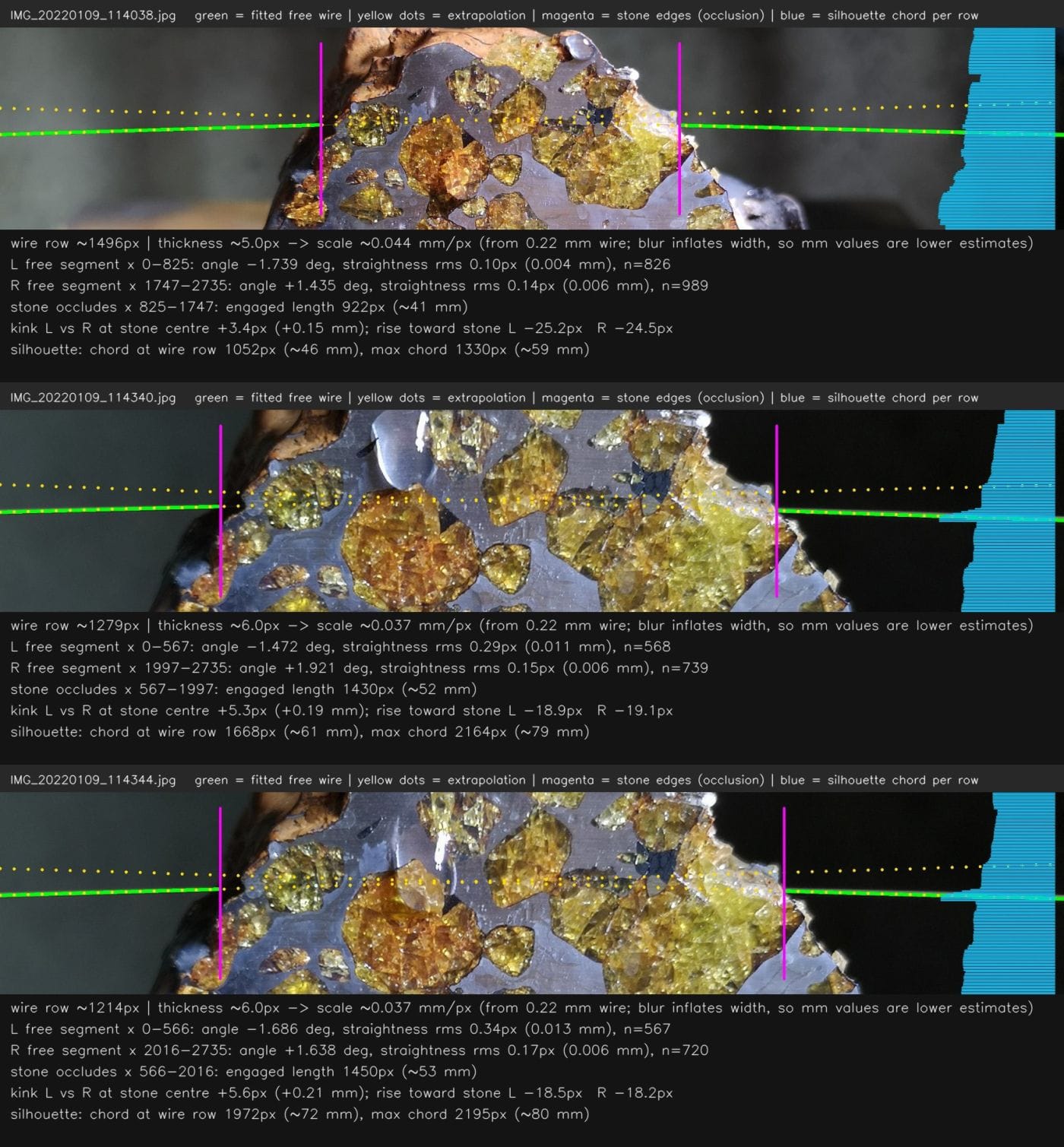
One and a half millimetres of deflection in a wire you chose for its 0.22 mm kerf. That is the number nobody sees, on every cut, on every wire saw ever built.
The same frame gives one more thing for free: the sample’s silhouette. Read the width of the stone at every height and you have the engaged length for the entire cut — before it starts. That is the exact information needed to stop guessing one feed rate for an irregular sample.
Where This Is Going
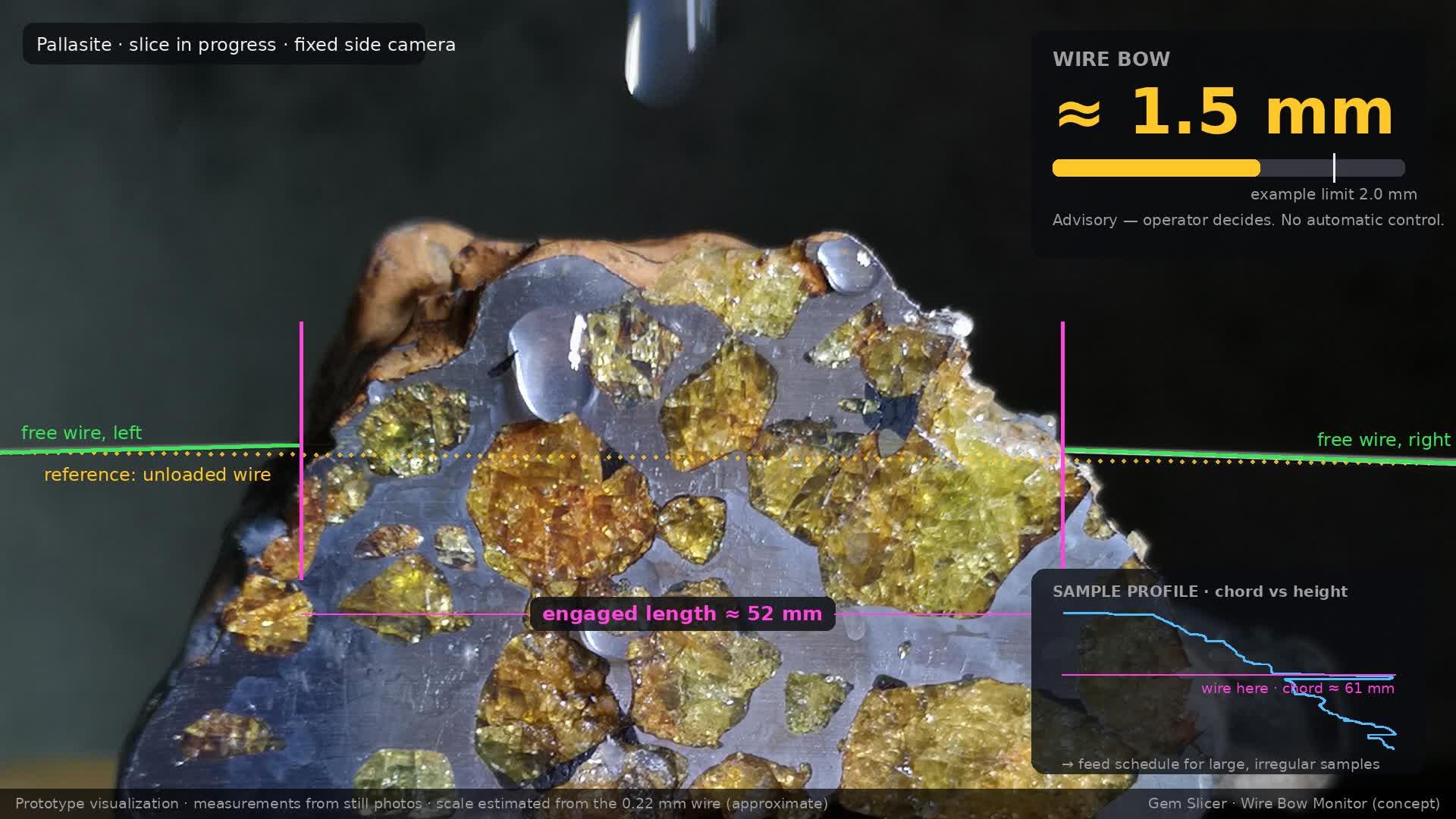
We are building this into the machine. The working name is the Wire Bow Monitor, and as of September 2026 it is a prototype: one fixed side camera, no extra sensors, showing the bow live on the camera screen — in millimetres, with a trend and a threshold you set per material. The same camera reads the sample profile, so the software can propose a feed schedule for large, irregular pieces instead of one speed for the whole cut.
Concept visualization: the bow numbers are real, measured from the frames above; the on-screen interface is a mockup of what the operator will see, not a recording of a working feature.
At this stage it moves nothing. It is a number and a hint; the operator decides. The step after that — once the measurement has proven itself in live cutting — is to let the same signal drive the feed: slow down as the wire bows, speed up as it straightens, within limits the operator sets. Adaptive feed, earned rather than promised. No release date yet, and we would rather show you working numbers than a roadmap.
Watch Your Own Wire
You do not need our monitor to use today’s lesson. Next long cut, stand where you can sight along the wire against a plain background, and watch what happens to the free segments as the cut reaches the widest part of the stone. What you will see by eye is what we measured above — and if your feed rate is set for the narrow entry, you will see it grow.
If what you cut bows more than you would like, tell us what you cut. We are at the Munich Show, 22–25 October 2026, stand B2.777 — come and argue with us about wire bow. It is our favourite subject this year.
Made by cutters, for cutters.