
Worked Concepts is a series of calculated scenarios for diamond wire cutting. Each one takes a real task, runs the numbers, and states where the scenario stops. This first one is a concept, not a facility we have built. Every figure comes from our machine specifications and from years of cutting meteorites ourselves, so you can check each one against your own.
The Task
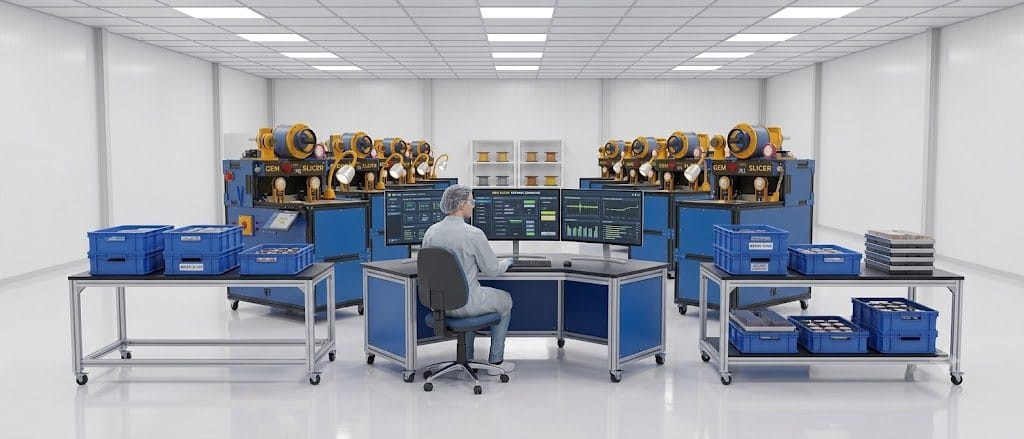
A meteorite business that slices its own stony material into 2 mm slabs for collectors wants to scale up. The question: what does a floor of ten Gem Slicer Standards produce, what does it cost to run, and what does it save?
Why Wire, for Meteorites
A stony meteorite is brittle, often fractured, and sold by the gram. Every millimetre that becomes dust is money, and every crack a blade opens is a slice lost. A 0.22 mm diamond wire removes a fraction of what a blade does, pushes on the stone with almost no side force, and runs cool under coolant. The thinnest slices we cut in stony meteorites are 0.25 to 0.3 mm. Few blade saws get anywhere near that.
The Yield, in Numbers
Take a stony meteorite of 10 × 10 × 10 cm, about 3.4 kg at a density of 3.4 g/cm³, and cut it into 2 mm slices. For a stone this size, a blade kerf of 1 to 2 mm is realistic:
| 0.22 mm wire | 1 mm blade | 2 mm blade | |
|---|---|---|---|
| Slices from the block | 45 | 33 | 25 |
| Material turned to dust | ~10% | ~33% | ~50% |
| Extra slices with wire | — | +12 (about 0.8 kg) | +20 (about 1.4 kg) |
| Value of the difference at €2/g | — | over €1,600 | over €2,700 |
Per cut, each pass through a 10 × 10 cm face saves 7.8 cm³, about 26 g of meteorite, compared with a 1 mm blade. At a conservative €2 per gram for a common chondrite slice, that is over €53 of material per cut that stays a slice instead of becoming sludge.
Throughput
Cutting speed varies from one meteorite to the next. As a working figure, one Gem Slicer Standard cuts about 40 cm of stony meteorite in a 20-hour automatic run. The other 4 hours of the day go to unloading, loading and wire changes. Ten machines cut about 400 cm a day.
Running Costs
Wire. A spool is loaded with about 70 m (not the full 80 m capacity) at around €0.24 per metre, so €16.80 a spool. It lasts roughly 50 to 60 working hours, and less with lower-quality wire. On the pessimistic end that is about €0.34 per hour of cutting, €0.17 per centimetre of cut, and €1.70 of wire for a cut that saves €53 of meteorite: roughly thirty to one.
Power. A Gem Slicer Standard draws up to 300 W. Ten machines on a 20-hour run draw at most 60 kWh a day, with real cutting below that.
Labour. One load takes about 40 minutes: gluing the specimen to the cutting adapter, preparing the machine, winding new wire when it is due, and starting the automatic cut. Ten loads add up to 6 hours 40 minutes, so one operator on one shift runs the floor.
The Room and the People
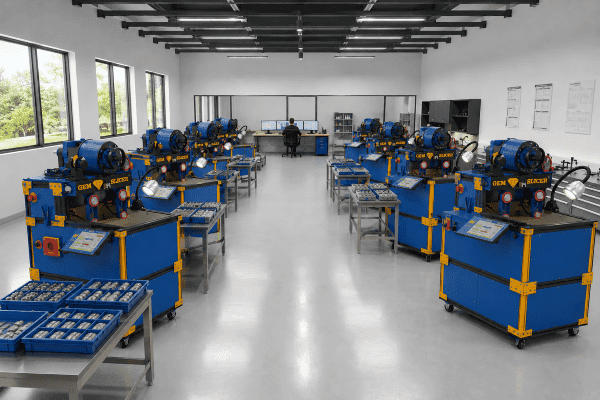
The concept fits 100 m²: two rows of five machines with a walking aisle between them, and room for twelve. Each saw stands on 52 × 80 cm, about 0.42 m², on casters, so the layout can change as the work changes. The spacing between units is set by what happens beside them: loading heavy specimens, changing wire, cleaning.
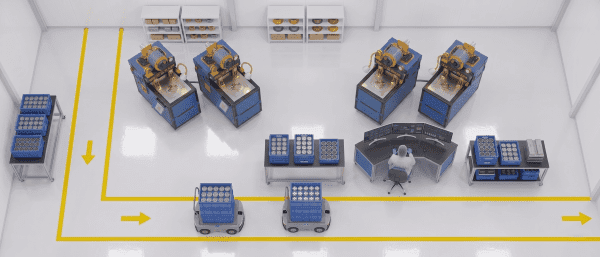
Every Gem Slicer has Wi-Fi, LAN, an integrated camera and AnyDesk remote access. From one desk, or from a phone, the operator sees every machine. Notifications when a run ends or stops are in development. More on the software.
Power from the Roof: the Honest Version
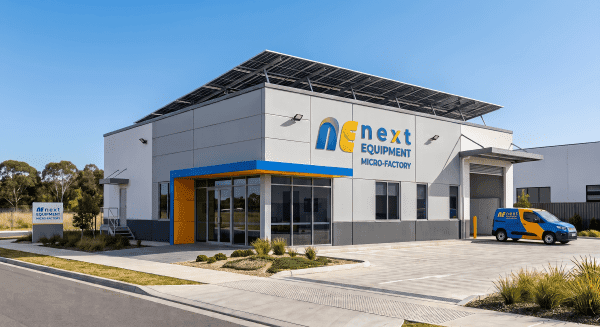
60 kWh a day is modest for ten production machines. A rooftop solar array can carry the daytime cutting. The overnight hours, which are the reason to own automatic saws, need either battery storage or the grid. Going off-grid is a question of battery size, and we would rather give you the numbers than the slogan.
One Day on the Floor
| Ten machines, one day | |
|---|---|
| Cutting | ~400 cm |
| Meteorite saved vs a 1 mm blade | over €2,100 of material that stays slices, not dust (at €2/g) |
| Wire | ~€67 |
| Power | at most 60 kWh |
| Operator time | ~6 h 40 min |
Where This Concept Stops
- Cutting speed varies by meteorite. Some stones cut faster than 40 cm a day, some slower.
- Wire life varies with wire quality. Our figures use the pessimistic end.
- Iron meteorites are not in this model; see what cuts well on a diamond wire saw. They cut slower and deserve their own Worked Concept.
- The €2/g is a conservative lower bound for common chondrite slices. Rarer material makes the saving larger, not smaller.
- The model says what the floor produces, not whether you can sell it. Ten saws cutting every day is a market question as much as a machine one.
- This is not a quote and not a throughput guarantee.
Run the Numbers for Your Material
Tell us what you cut, in what sizes and how much, and we will lay out the floor for your room and give you the figures for your material. Custom saws and cutting farms → · Tell us what you cut →
2 thoughts on “Worked Concept: A 10-Saw Meteorite Cutting Farm in 100 m²”
Comments are closed.