
What NEXT is where we show machines and features we are working on before they exist. Everything below is a design concept. Nothing here is on sale yet, and every number is an example or a target until the prototype proves it.
We are building Next Equipment Connect: Gem Slicer saws that report what they are doing, a camera that watches the diamond wire through the night, and one connector that lets you ask Claude, ChatGPT or Gemini about your machines in plain language.
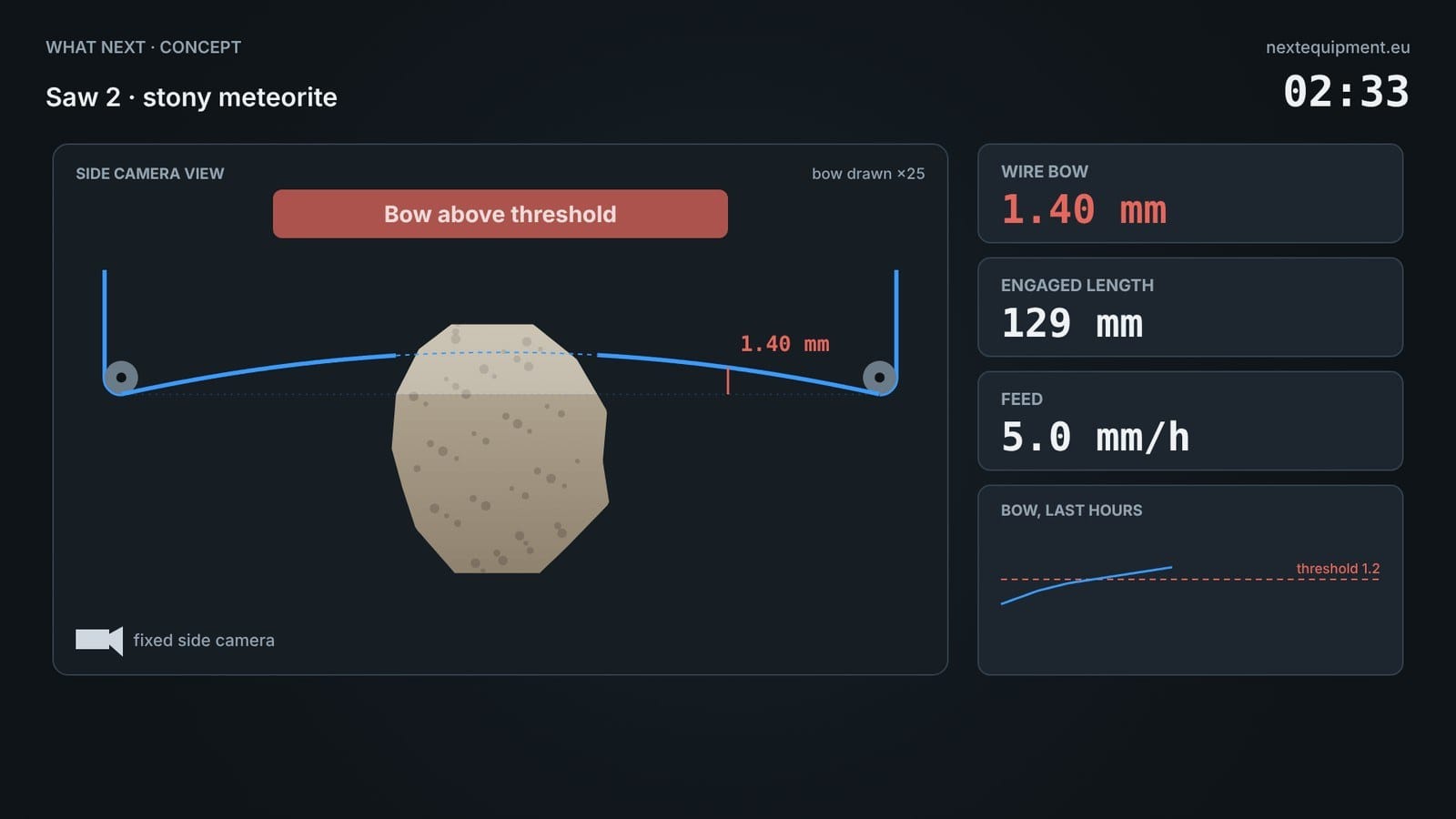
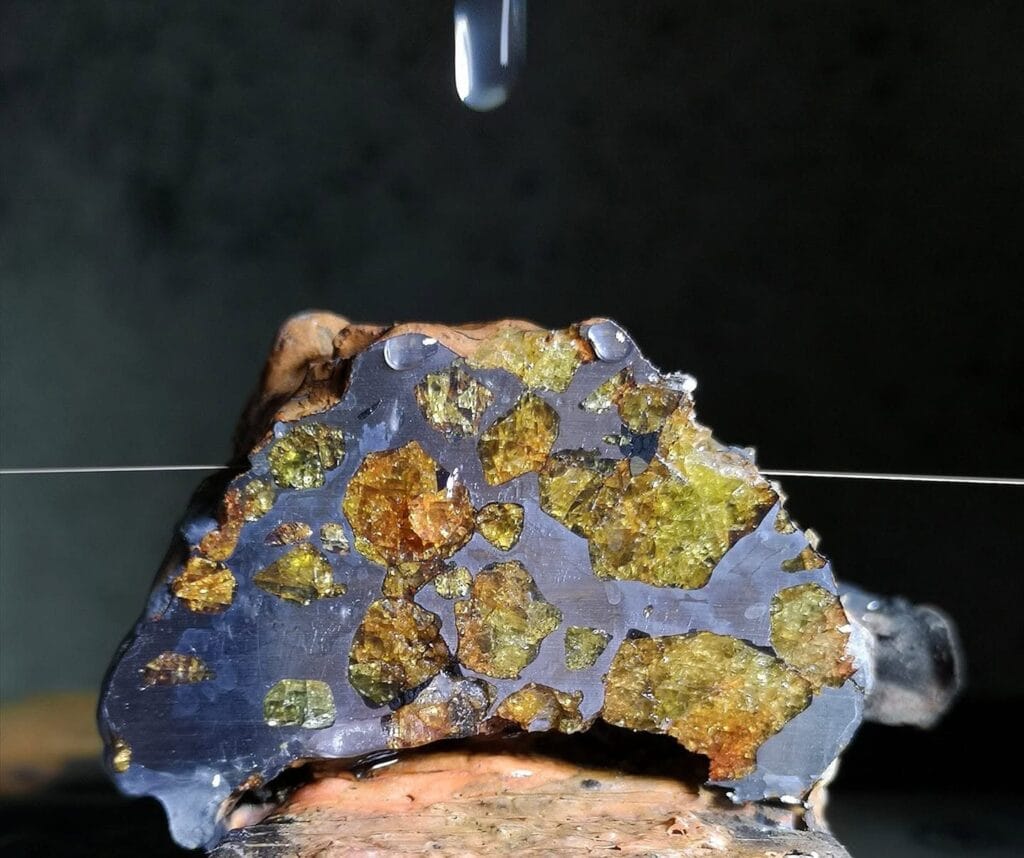
At the centre of it is the Wire Bow Monitor. In September we showed that a single side camera can read how far a 0.22 mm wire bends inside the stone: about 1.5 mm in the middle of a pallasite cut. This article is about what happens next. What the saw does when it knows that number, and what changes when someone other than the person standing next to the machine can see it.
The cut nobody watches
Diamond wire cutting is slow by nature, and that is the price of a 0.22 mm kerf. On a large stony meteorite, about 15 cm of cut takes around 20 hours of machine time. So the long cuts run at night and over weekends, and the saw works alone.
The Gem Slicer already looks after itself when it is alone. If the wire breaks, the machine stops. Automatic slicing works through a whole table of slices without help. What it cannot do is tell anyone. A wire that breaks at 1 a.m. is found at 8 a.m., and seven hours of a 20-hour job are gone. On one saw that is an annoyance. In a room with ten saws it is a schedule.
The stop is the failure you can see. The one you cannot see is the feed rate: how fast the stone is pushed into the wire. Today it is set once, before the cut starts, and stays the same to the end. But an irregular stone is narrow at the top, wide in the middle and narrow again at the bottom, so in the middle the wire has far more stone to cut through at once. Set the feed for the narrow parts, and in the middle the wire is overloaded, bows hard and risks breaking. Set it for the middle, and the narrow parts are cut much slower than they need to be. The operator picks a compromise at six in the evening and lives with it until morning.
What the saw knows, and what it doesn’t
The saw’s controller already knows a great deal: where each axis is, whether the reel is turning, which slice of the table it is on, every alarm, its running hours. Today that information lives on the machine’s screen and nowhere else.
What it does not know is the one thing behind most bad nights: how bent its own wire is. That is the camera’s job.
The Wire Bow Monitor
A fixed camera looks at the wire from the side. The wire inside the stone is hidden, but the free segments on either side of it are not. When the wire bows, both segments tilt towards the stone. The angle between them gives the bow in millimetres. The same frame shows the outline of the stone, so the saw knows how much wire will be in the stone at every height before the cut gets there. That is the engaged length, and it is what drives the cutting force.
We are building it in three steps, and each one has to prove itself before the next.
- Watch. The bow is shown live, in millimetres, with a trend and a threshold set per material. It moves nothing. This is where the prototype is today.
- Warn. When the bow crosses the threshold, or keeps growing while the engaged length does not, the operator is told: on the machine, and on the phone.
- Ease off. Adaptive feed. As the bow grows, the saw slows the feed. As the wire straightens, it returns to the feed the operator set. It never feeds faster than that.
Two rules apply to step three. First, adaptive feed is not a safety function. Stopping on a broken wire, the tension-arm lock and the emergency stop stay in the machine’s own controller and wiring, whatever the camera reports. Second, the model that turns camera frames into a feed decision is a fixed, tested version. It does not quietly retrain itself on a customer’s machine. The new EU Machinery Regulation treats machines whose behaviour keeps evolving after delivery with particular care, and we would rather ship a version we can stand behind.
Where does it pay most? In cutting farms. The same material goes through day after day, a few percent of feed on every cut adds up, and one person looks after many saws through the night.
How the saws connect
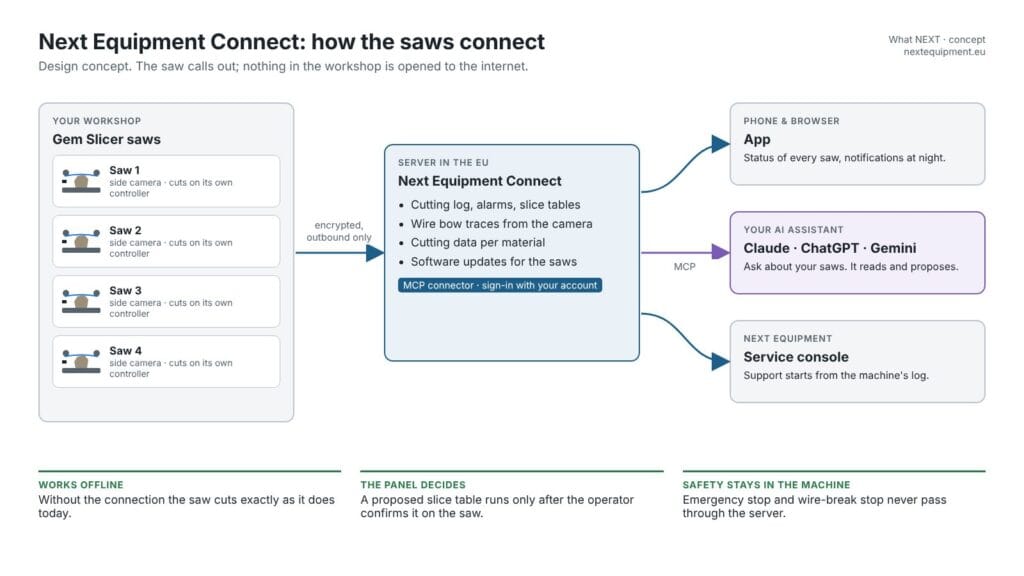
- The saw calls out. Each machine opens an encrypted connection outwards to our server in the EU. Nothing in your workshop is opened to the internet: no port forwarding, no remote-desktop software.
- The server keeps the record. Cutting logs, alarms, slice tables and bow traces are stored there and shown in an app on the phone and in the browser.
- Support starts from data. A service console lets us see the health of a machine, so a support call starts from its log rather than a description over the phone. Software updates arrive the same way.
- The saw does not need any of it. If the connection or the server is gone, the saw cuts exactly as it does today.
Remote stop is always possible. Remote start works only if it has been allowed on the machine’s own panel. Emergency functions never pass through the server.
Ask your saw
This is the part we find most interesting. The server will speak the Model Context Protocol (MCP), the open standard that AI assistants use to reach outside tools and data. Anthropic introduced it in 2024, and it is now governed by the Agentic AI Foundation under the Linux Foundation, with OpenAI and Google among the members. Claude, ChatGPT and Gemini can all connect to a remote MCP server. Which of their plans allow custom connectors differs between them and changes often.
So there will be one connector, signed in with your own account, and you use it from the assistant you already have. Questions like these:
- “Which saws had trouble overnight, and why?”
- “How far is saw 3 into its table, and when will it finish?”
- “The bow on saw 2 went up after 2 a.m. Was it the stone getting wider?”
- “I have a 12 cm ordinary chondrite. Propose an automatic slicing table for 2 mm slices.”
The assistant answers from the machine’s own log and from our cutting data for the material, not from guesswork. It can read and it can propose. It cannot start a cut. A slice table it writes appears on the saw’s panel and runs only after the operator has confirmed it there.
Security and your data
- No default passwords. A saw cannot be reached until its owner has set up access.
- Built to the Cyber Resilience Act. The EU regulation for products with software sets the rules for security updates and for handling vulnerabilities. We design the connected saw to it from the start.
- Your cutting data is yours. We use it to improve the bow model only with your consent.
Try it: a night on the farm
Below is a working simulation of the farm console: four saws, from six in the evening to eight in the morning. Saw 2 is cutting a wide stony meteorite with the monitor set to warn only. Watch what happens to its wire after midnight, then restart the night and switch it to adaptive feed. On the right, ask the saws questions. The answers are built by simple rules from the simulated log, to show the kind of answer the real connector will give.
What it will not do
- Cut by itself. The assistant proposes. The operator confirms on the panel.
- Replace judgement on a new material. The bow is a measurement, not an opinion. Thresholds for a material come from cutting it.
- Make the saw depend on us. Without the internet, the saw is the same machine it is today.
- Give proven numbers yet. Until the camera has watched many real cuts, the thresholds and the gain from adaptive feed are our estimates.
Where we are
The bow has been measured from camera frames of real cuts. A compact camera is fitted to a Gem Slicer while we settle its position and optics. The connection design is done, and the software work starts with a review of the existing machine code. There is no release date, and we would rather show working numbers than a roadmap. The next What NEXT update on this will have them.
If you run several saws, or cut through the night, we would like to hear from you. What would you want to know at three in the morning? Those answers set the specification. Tell us what you cut.
Made by cutters, for cutters.